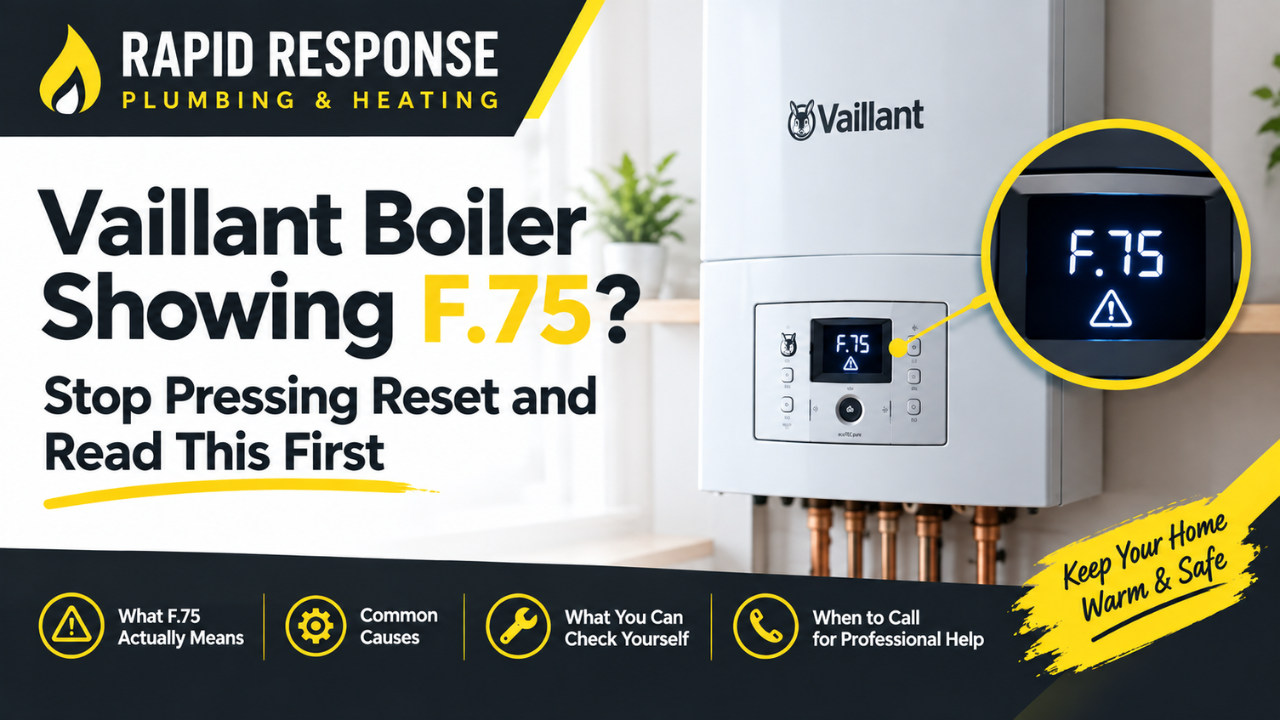
You’ve pressed reset three times now. The boiler fires up for a second, thinks about it, then flashes F.75 again and shuts itself down. Sound familiar?
We get calls about this one a lot, and honestly, it trips people up more than most Vaillant faults because there’s no single, tidy explanation for it. F.22 is easy: low pressure, top it up, done. F.75 isn’t like that. It could be the pump, it could be a sensor, it could be years of sludge finally catching up with your system. So resetting it over and over doesn’t fix anything, it just buys you a few more minutes before the same lockout happens again.
This guide is here to save you that cycle. We’ll go through what F.75 actually means, what’s usually behind it in London homes specifically, what you can safely check yourself (not much, if we’re being honest), and when it’s time to just pick up the phone and book an emergency boiler repair service in London. If you’d rather see every Vaillant code in one place, we’ve also put together a full Vaillant boiler error codes guide covering the rest of them.
So What Is F.75, Actually?
Here’s the short version. When your Vaillant boiler fires up the heating pump, it expects to see a specific rise in water pressure straight after. That’s the boiler’s way of confirming the pump is doing its job and water is actually moving. If that expected pressure change doesn’t show up on the sensor, the boiler assumes something’s wrong and locks itself out rather than carry on regardless.
It’s a sensible safety feature. It’s also frustratingly vague, because “the pump didn’t do what I expected” could mean half a dozen different things depending on what’s inside the system.
What’s Usually Causing It
A pump that’s on its way out. By far the most common reason we find, especially on older installs. The pump either seizes up partially or just isn’t spinning fast enough to generate the pressure change the boiler is looking for. Sometimes you’ll hear it humming without actually moving much water, which is a fairly clear tell.
Sludge that’s built up over years. This one’s very much a London problem. Between the hard water across most of the capital and the amount of old pipework still sitting behind walls in Victorian and Edwardian terraces around Hackney, Islington and Stoke Newington, sludge accumulates in radiators and pipes over time and eventually works its way down toward the pump. Once that happens, flow drops off and F.75 shows up.
A pressure sensor that’s given up. Occasionally the pump is fine and it’s the sensor reading it that’s failed or gone inaccurate. From the boiler’s point of view the result looks identical, no detected change, lockout.
Air trapped somewhere in the system. If a radiator’s recently been bled, or the system’s been drained and refilled for any reason, trapped air can throw off the pressure readings enough to trigger this.
Pressure that’s already borderline low. If the system’s sitting near the bottom of its safe range to begin with, the pump might struggle to produce a change big enough for the sensor to register, and you can end up with F.75 showing alongside, or instead of, a low-pressure code.
Can You Fix This One Yourself?
Mostly, no, and we’d rather be straight with you about that than pretend otherwise. F.22 has a genuine DIY fix. F.75 really doesn’t, because the problem sits inside the boiler’s mechanics rather than being something you can top up or bleed your way out of.
There are two things worth doing before you call anyone, though:
- Check the pressure gauge sits between 1.0 and 1.5 bar. If it’s noticeably low, top it up with the filling loop and try one reset. Sometimes low pressure is confusing the pump reading, and this clears it.
- Think back to whether anyone’s bled a radiator or drained the system recently. It’s a small detail, but it helps whoever comes out narrow down where to start looking.
Past that, you’re into pump, sensor and wiring territory, and that’s not something to open up yourself. Aside from the safety issue on a gas appliance, it’ll likely void your warranty too.
Why Repeated Resets Make It Worse, Not Better
One reset after checking pressure is fair enough. Doing it five times in a row isn’t, and here’s why it matters.
It doesn’t actually fix the fault. If the pump’s seized or the sensor’s dead, resetting just restarts the exact same failed check, which fails again a few minutes later. You’re not troubleshooting, you’re just delaying.
More importantly, forcing a boiler to keep trying to run without proper water circulation puts real strain on the heat exchanger. That’s how a £150 pump job turns into a much pricier heat exchanger repair a few months down the line. Not worth the risk of one more reset to save yourself a phone call.
What Happens When We Come Out for an F.75 Fault
Because this code can come from a few different places, getting the diagnosis right matters more here than with most other faults. When you book us for an emergency boiler repair in London over an F.75 lockout, here’s roughly what happens:
A Gas Safe registered, Vaillant approved service engineer turns up with common pump and sensor parts already in the van, so most jobs get sorted in one visit rather than two. They’ll check system pressure, have a proper look at the pump for seizing or blockage, and test the pressure sensor readings against what the boiler expects to see. If sludge turns out to be the root cause, we’ll talk you through whether a power flush makes sense, because replacing the pump on its own won’t help much if the whole system’s still full of debris that’ll just clog the next one too.
You get a fixed price before anything gets touched, and we cover Hackney, Islington, Tower Hamlets, Newham, Southwark and most of Greater London with same-day appointments seven days a week.
How Does F.75 Compare to Other Vaillant Codes?
| Code | What it usually means | DIY-friendly? |
| F.22 | Low water pressure | Usually, top up and reset |
| F.75 | Pump or pressure sensor not registering a change | No, needs an engineer |
| F.28 / F.29 | Ignition or flame failure | No, gas fault |
| F.27 | False flame detected | No, gas safety issue |
For the full rundown of what every Vaillant code means, take a look at our Vaillant boiler error codes guide, or the broader guide to fault codes across Vaillant, Worcester, Ideal and Baxi if you’re not even sure which brand’s involved.
What Does It Cost to Fix?
Fair question, and the honest answer is it depends what we find. Because F.75 usually involves an actual part failing rather than a quick top-up, it tends to land toward the higher end of typical repair pricing. A sensor swap is a smaller job. A pump replacement costs more. A full power flush to clear sludge across the whole system is bigger still. We diagnose first, then give you a fixed number before any work starts, so you’re never guessing what the bill’s going to look like. Our guide on boiler repair costs in London breaks pricing down by fault type if you want a fuller picture.
When to Actually Treat This as an Emergency
We’d call it urgent, not something to sit on for a few days, if:
- The fault keeps coming back straight after a reset
- You’re hearing banging or gurgling alongside it, which often means sludge is involved
- There’s no heating or hot water and you’ve got kids, elderly relatives, or anyone vulnerable to the cold in the house
- You’re a landlord and this is happening in a tenanted property, where you’ve got both comfort and gas safety obligations to think about
Why People Call Rapid Heat 247 for This
For Vaillant boiler repair in London, homeowners and landlords across Hackney and beyond tend to come back to us for a few reasons. Our engineers are Gas Safe registered and specifically trained as Vaillant approved service engineers, so they’re not just working from a general gas appliance manual, they actually know these systems. We keep genuine Vaillant parts on the van, which is why most F.75 jobs get wrapped up in one visit. We cover Hackney, Islington, Tower Hamlets, Waltham Forest, Newham, Southwark and most of Greater London, with 24/7 emergency slots when you need one. And if a repair is the sensible option, that’s what we’ll tell you, we’re not in the business of pushing a new boiler when your current one’s got years left in it.
If faults like this keep cropping up on your system, it might be worth a wider read of our piece on common Vaillant boiler problems and how to actually fix them.
Book Your F.75 Repair
An F.75 fault isn’t going to sort itself out, and every extra reset just adds a bit more strain to a system that’s already struggling. If your Vaillant’s stuck flashing this code, the quickest thing to do is stop guessing and get someone out.
Call us on 07888078885 to speak with a Gas Safe registered, Vaillant approved engineer, or book online at www.rapidheat247.co.uk.
Frequently Asked Questions
It means the boiler switched the pump on but didn’t detect the pressure change it expected afterwards. Usually that points to a stuck pump, a faulty sensor, sludge in the system, or trapped air.
Not really, beyond checking the pressure gauge and trying one reset. If it comes back, the cause is almost always something inside the system that needs a proper look from a Gas Safe engineer.
No, and it’s worth knowing the difference. F.22 is just low pressure, often fixed at home with a top-up. F.75 is about the pump and sensor not behaving as expected, and that’s a repair job, not a top-up job.
Because resetting only clears the lockout, it doesn’t fix whatever caused it in the first place. If the pump’s seized or the sensor’s faulty, you’ll get the same fault back within minutes.
We run same-day emergency callouts seven days a week. Call before midday and you’ve got the best shot at getting seen that day.