
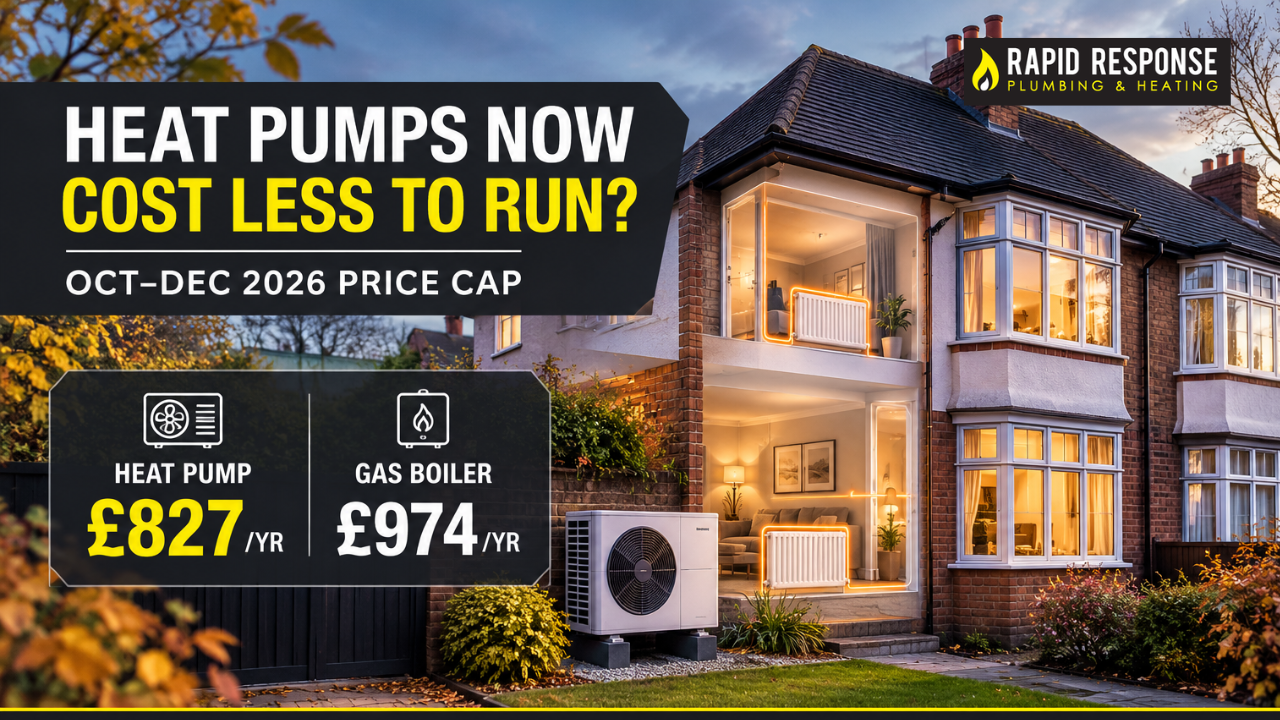
Something shifted this quarter that most homeowners haven’t clocked yet. Under the Ofgem price cap covering 1 October to 31 December 2026, running a correctly installed air source heat pump now works out cheaper than running a gas boiler, on an ordinary standard electricity tariff, with no clever tricks involved. That hasn’t been true for a while. Back in April, the same comparison still favoured gas. The cap that followed in October flipped it.
At Rapid Response Plumbing and Heating, this is suddenly the first question most callers ask, so rather than repeat the usual rounded-off marketing figures, here’s where the numbers actually land, what changed behind the scenes, and what it means if you’re weighing up air source heat pump installation in London this winter.
What Actually Changed in the October 2026 Price Cap
Two separate price movements happened together. Gas went up by around 8.7% under the new cap, while electricity barely moved, rising under 1%, and lost its 5% VAT charge in the process. Electricity VAT has been suspended until 31 March 2027 as part of the government’s broader push to make switching more affordable. Put the two together and gas now sits at roughly 7.97p per kWh including VAT, against standard electricity at roughly 26.32p per kWh with none. The ratio between the two fuels is still around 3.3 to 1, but that’s tight enough now for an efficient heat pump to come out on top on running cost alone, something that simply wasn’t true a year ago.
Gas Boiler or Heat Pump: What the Numbers Actually Show
Picture a typical three-bedroom semi getting through around 11,000 kWh a year between heating and hot water. Run the sums at current prices and you get this:
- A 90% efficient gas boiler lands at roughly £974 a year.
- An air source heat pump hitting a seasonal efficiency rating, known as SCOP, of 3.5, a realistic figure for a system that’s been sized and set up properly, lands at roughly £827 a year on a standard tariff.
That’s about £147 a year in the heat pump’s favour. It won’t transform anyone’s finances overnight, but it’s a genuine reversal from where things stood six months earlier, when the heat pump would have cost more to run under the previous cap. Every indication points to that gap growing rather than shrinking, since gas keeps climbing faster than electricity, and the government’s own direction of travel is clearly aimed at keeping it that way until at least March 2027.
If you want the fuller picture on how this stacks up against replacing an older, tired system, our piece on the long-term benefits of switching to an ASHP builds on this nicely.
The Saving Grows Further With the Right Tariff
Those figures above are the starting point, not the best case. A handful of UK suppliers now sell tariffs built specifically around heat pump usage patterns, charging less during the hours a heat pump is typically working hardest: early morning, mid afternoon, and late evening. Switch to one of these and that same three-bedroom household can see its running cost fall to roughly £629 a year, a saving closer to £345 against gas, more than double what the standard tariff delivers.
The catch is behavioural rather than technical. You need the system pre-heating the home during those cheaper windows and easing off during the evening peak, which most modern controllers now manage on their own once they’re configured properly. Getting this set up correctly on day one is exactly the kind of detail that separates a system that performs from one that quietly underwhelms, and it’s something we build into every commissioning we do.
What Air Source Heat Pump Installation Actually Involves
It helps to know what you’re signing up for before booking anything. A proper installation isn’t a same-day swap like a combi boiler change. Here’s the realistic sequence:
A full heat loss survey first. Before any kW figure is quoted, a qualified engineer should assess the property room by room, checking insulation, glazing, and existing radiator sizes. This is the single step that determines whether a system hits SCOP 3.5 or disappoints everyone later.
Sizing and radiator checks. Most homes need somewhere between zero and three radiators upgraded to work comfortably at the lower flow temperatures a heat pump uses. A quote promising a full house of new radiators, or none of the above, deserves a second opinion.
Outdoor unit placement. The unit sits outside on a wall bracket or ground pad, positioned to meet current noise rules, covered below.
Pipework, electrics and the hot water cylinder. Homes currently running a combi boiler will usually need a hot water cylinder fitted, since heat pumps don’t produce instant on-demand hot water the way a combi does.
Commissioning with weather compensation switched on. This is the step that gets rushed on a poor installation and is the main reason a heat pump ends up costing more than the gas boiler it replaced. Weather compensation lets the system automatically lower its flow temperature on milder days, which is where most of the running cost saving actually comes from.
Most straightforward installations in London take two to four days. Larger properties needing a new cylinder and radiator work can take longer.
Why the Installation Itself Decides Whether You See Any of This
Every figure quoted earlier assumes the heat pump is actually achieving something close to SCOP 3.5. Drop below roughly 2.97, which is the break-even point against a 90% efficient gas boiler, and the heat pump can end up costing more to run than the system it replaced. The usual culprits are a unit sized without a proper survey, radiators that were never upgraded, or a flow temperature left too high at commissioning.
This is why every quote we give starts with an actual heat loss survey rather than a phone-based estimate. If you’re currently comparing installer quotes, our guide to smarter air source heat pump options in London runs through the shortcuts worth questioning before you sign anything.
Planning Permission: What’s Changed Recently
Most air source heat pump installations in England still fall under permitted development, meaning no planning application is needed, but the rules around noise were updated under MCS 020(a), which came into force in England in 2025. The commonly repeated “one metre from the boundary” rule has effectively been replaced by a sound calculation instead, assessed at the neighbour’s nearest window or door. A competent installer will run this calculation as part of your design and should be able to show you the result before work starts. Conservation areas, listed buildings, and flats can carry extra restrictions, so it’s worth confirming your property’s status before committing to a date.
What This Shift Means If You’re Considering Installation Now
If you held off switching because the running costs never quite added up, this is the first price cap period where the comparison genuinely tips in the heat pump’s favour, and more so once a heat pump tariff is layered on top. There’s also still £7,500 available through the Boiler Upgrade Scheme for most eligible homes, rising to £9,000 for off-grid properties replacing oil or LPG, and installation remains free of VAT until 31 March 2027. We’ve gone through exactly how that grant works in our post on getting £7,500 off switching from a gas boiler to an air source heat pump.
For the full walkthrough of what installation involves from first call to handover, our in-depth guide to choosing an air source heat pump is the natural next read.
Got a Heat Pump Already That Isn’t Delivering These Savings?
If your system went in a year or two back and the bills haven’t moved the way you expected, the technology usually isn’t to blame. More often than not, it’s weather compensation that was never switched on correctly, a flow temperature set too high from the start, or a developing fault quietly pulling efficiency down. This is where our air source heat pump repair services in London come in. We run diagnostics, fix refrigerant and electrical faults, and carry out full efficiency reviews on any system regardless of who installed it, and we regularly bring underperforming units back up to the kind of SCOP that genuinely beats gas.
What You Get Working With Rapid Response
Whether this is a first installation or an existing system that needs attention, our own engineers handle the entire job rather than handing it off to a subcontractor. The full scope is listed on our Heat Pump Installation page.
- A proper heat loss survey before any quote is written
- Gas Safe and heat pump qualified engineers covering London
- Help with Boiler Upgrade Scheme grant paperwork
- Air source heat pump repair services for existing systems, any brand
- 24/7 availability for anything urgent
Get a Quote That Reflects Where the Numbers Stand Now
If this quarter’s price cap has you rethinking the switch, or an existing heat pump isn’t pulling its weight, get in touch with Rapid Response Plumbing and Heating. Visit www.rapidheat247.co.uk or call 07888078885 to book a survey or arrange a repair.
Frequently Asked Questions
Under the current Ofgem price cap (1 October to 31 December 2026), a well-installed heat pump running at around SCOP 3.5 costs roughly £827 a year to heat a typical three-bedroom home on a standard tariff, against roughly £974 for a 90% efficient gas boiler.
Gas rose by around 8.7% under the October 2026 cap, while electricity rose by less than 1% and lost its 5% VAT charge, suspended until 31 March 2027. That narrowed the price gap enough for an efficient heat pump to come out cheaper.
No, the saving holds on a standard electricity tariff. A dedicated heat pump tariff increases it further, but isn’t a requirement.
Most installations fall under permitted development provided they pass the MCS 020(a) noise calculation. Conservation areas, listed buildings, and some flats carry extra restrictions, so it’s worth checking before booking.
It’s almost always down to how the system was installed or configured, most commonly weather compensation that was never set up properly. Our air source heat pump repair services in London include efficiency diagnostics for exactly this.