Autumn has barely started and the energy price cap has already moved again. For anyone in a London flat or terrace with a gas boiler, the big question is simple: how do you stay warm without watching the meter spin?
In short: The biggest savings usually come from a serviced boiler, a lower flow temperature (where your manual allows), radiators that heat properly, room by room temperature control and a sensible heating schedule. Add draught proofing and a tariff check, and most households can trim waste before January.
Below you will find what the new cap means in plain terms, followed by nine steps ordered from the easiest to the most involved.
What the October 2026 Price Cap Means for Your Home
From 1 October to 31 December 2026, Ofgem’s cap for a typical household paying by Direct Debit rises 4%, from £1,663 to £1,723 a year. Ofgem links the rise mainly to higher wholesale gas prices.
Keep three things in mind:
- The cap controls the price per unit and the daily standing charge. It does not limit your total spend. A leaky, poorly tuned home uses more units, so it costs more.
- The cap is reviewed every quarter. Some analysts expect another increase from January 2027, which makes preparation sensible rather than premature.
- VAT is off household electricity from 1 October 2026 until 31 March 2027. That helps, but gas is what warms most London homes, so your boiler remains the main target.
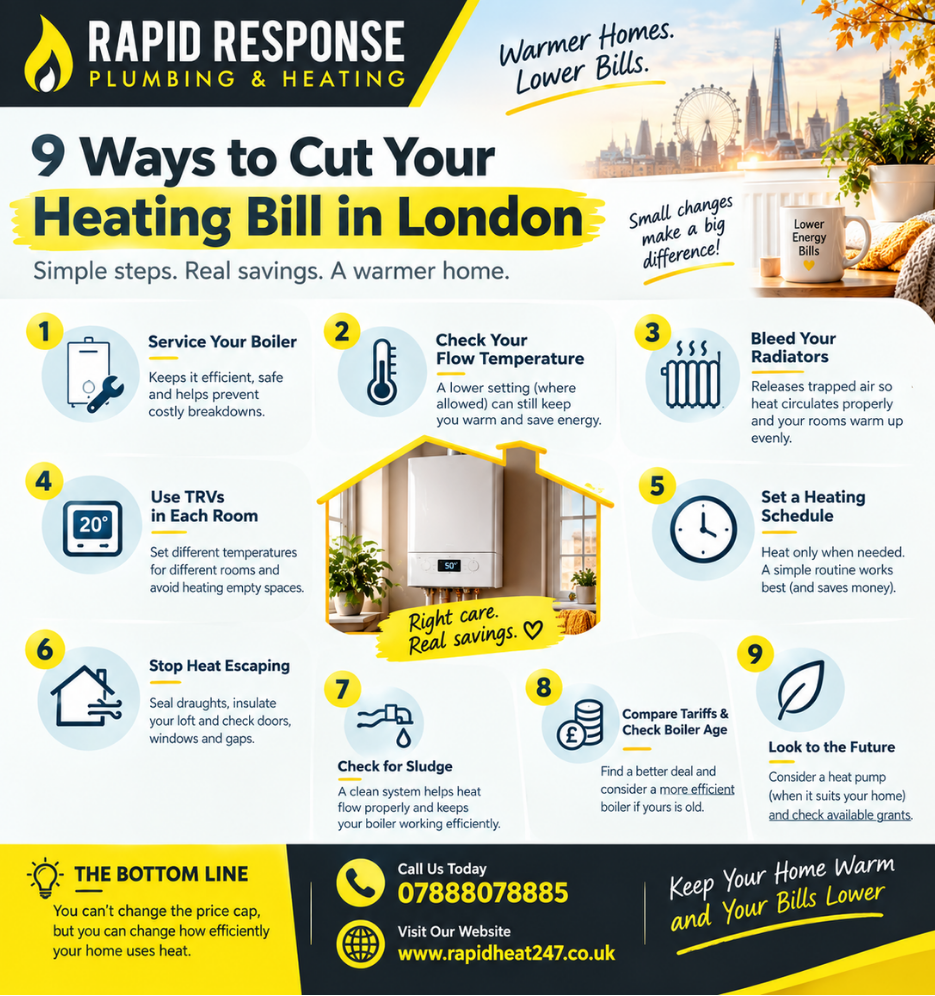
1. Get the Boiler Serviced Before the Cold Arrives
A boiler service is about more than routine maintenance. It gives an engineer the opportunity to check key components, including the burner, heat exchanger, flue and safety controls, to help ensure the system operates as it should. During the inspection, small faults or unusual signs of wear may also come to light before they develop into more disruptive problems, particularly when the boiler is working harder during colder months.
Autumn appointments are easier to get than mid winter ones. Worcester Bosch owners can see how our Worcester Bosch boiler service engineers near me page works.
2. Ask About Your Flow Temperature
Your boiler’s flow temperature controls how hot the water is when it leaves the boiler and travels through your radiators to warm your home. Condensing boilers are designed to recover extra heat from exhaust gases, but they only manage this properly when the returning water is cool enough.
Many homes run with a high factory setting that they do not need. In a reasonably insulated property, a lower setting may still keep rooms comfortable. The right figure depends on your boiler, radiators and house, so check the manual or ask an engineer. Do not lower the hot water temperature below the level your engineer or manufacturer advises.
3. Release Trapped Air From Radiators
If your radiator feels warm at the bottom but cold at the top, trapped air could be the reason. Before turning up the thermostat, try bleeding the radiator to release the air and help heat circulate properly. Switch off the heating and let the radiator cool down. Place a cloth and a small container under the bleed valve, then gently open it with a radiator key. You’ll hear the air escaping. Once water starts coming out, close the valve securely. Afterward, check your boiler pressure and adjust it if needed, following the manufacturer’s guidance. It’s a simple job that can help your room warm up more evenly.
4. Give Each Room Its Own Setting
Thermostatic radiator valves, usually called TRVs, let you choose how warm each room gets. A guest room can stay mild while the living area and the room where you work from home stay comfortable. They are simple for an engineer to fit and suit London homes with several rooms of different use.
5. Heat Only When It Matters
Think about when the house is actually occupied. A programmer or smart thermostat can bring the heating on shortly before you wake up or arrive home and switch it off when everyone has left. Choose a plain, repeatable schedule. If it is too clever, people override it, and the savings disappear.
6. Stop Heat Escaping
Older London properties often lose warmth through window frames, front doors, letterboxes, chimneys and gaps between floorboards. Cheap draught strips and sealant make a visible difference. If you have a loft, check the insulation depth as well, since heat rises and escapes upwards.
7. Check Whether Sludge Is Holding Your System Back
Radiators that feel warm at the top and cold at the bottom often contain a build up of rust and debris. The boiler has to work harder to push heat through, and some rooms never get comfortable. Our power flushing guide for London homes shows the warning signs and what the cleaning process involves.
8. Compare Tariffs and Think About Boiler Age
At the time of the announcement, Ofgem said fixed deals were available more than £100 below the October cap. Offers change quickly, so compare live prices and look at exit fees before you switch.
Also ask how old your boiler is. Many last between 10 and 15 years, and older models can be less efficient than modern condensing units. If yours has needed repeated fixes, it may be time to compare repair costs against replacement. Our guide to boiler installation costs in London explains what drives the price, and our boiler finance page covers payment options.
9. Look Further Ahead
Some homeowners are weighing up a heat pump. The Boiler Upgrade Scheme offers up to £7,500 towards an air source or ground source heat pump in England and Wales, where the property qualifies. Not every home suits one, because insulation, space and radiator sizes all matter, so a proper survey comes first. Learn more about heat pump installation and maintenance in London or read whether gas boilers are being banned in 2026.
Savings That Are Not Worth the Risk
Some money saving ideas create dangers. Steer clear of these:
- Heating a room with a gas oven or hob.
- Covering or boxing in the boiler, or blocking vents.
- Carrying on with a boiler that leaks, smells odd or keeps shutting down.
- Taking off boiler panels or attempting gas repairs yourself.
- Letting carbon monoxide alarm batteries go flat.
A boiler in poor condition can waste fuel and put your household at risk. Gas work always belongs with a Gas Safe registered engineer.
If the Boiler Fails Mid Winter
A boiler can stop at the worst possible moment. When that happens, read about emergency boiler repair in the City of London. People in the east of the capital can look at emergency boiler repair in Hackney and Worcester boiler repairs in Hackney.
Our London winter heating checklist pairs well with the steps above.
Prepare Your Heating Before the Cold Bites
You cannot change the price cap, but you can change how efficiently your home uses heat. Visit www.rapidheat247.co.uk to book, or call Rapid Heat 247 on 07888078885 for immediate service.
Frequently Asked Questions
Ofgem set the typical annual dual fuel bill at £1,723 for Direct Debit customers between 1 October and 31 December 2026. It was £1,663 before. Your own cost depends on how much gas and electricity you use.
Start with free changes: bleed radiators, set a simple heating schedule and seal obvious draughts. Then book a boiler service and ask an engineer about flow temperature and TRVs.
Often it can, particularly when the old boiler is inefficient. The result depends on your property, your habits and the model installed, so ask for advice based on your own home.
There is no single answer. Insulation, the building and your routine all matter. For many homes, heating only when needed with a plain timer works well.
Rapid Response Plumbing and Heating handles boiler servicing, repairs and emergency call outs across London. Call 07888078885 or visit www.rapidheat247.co.uk.