You notice a boiler error code flashing on the display, and your first instinct is to Google it. That instinct is not wrong, but it is incomplete. Search “Worcester F22” or “Vaillant F28” and you will land on a list explaining what the code means. What almost none of those lists tell you is how worried you should actually be right now, tonight, in your own home.
That is the gap this guide fills. Every error code guide is organised the same way: by brand, then by code number, as if the code alone tells you what to do next. It does not. The code identifies the fault. It says nothing about whether that fault is safe to sleep on or needs a call right now, and that second question is usually the one you came here to answer.
So, this guide works the other way round. Instead of starting with the code, it starts with the only question that matters in the moment: is this serious, and what should you do in the next five minutes.
The Three Questions That Matter More Than the Code
Before checking any code against any list, answer these three questions. They override everything else, regardless of what the display is showing.
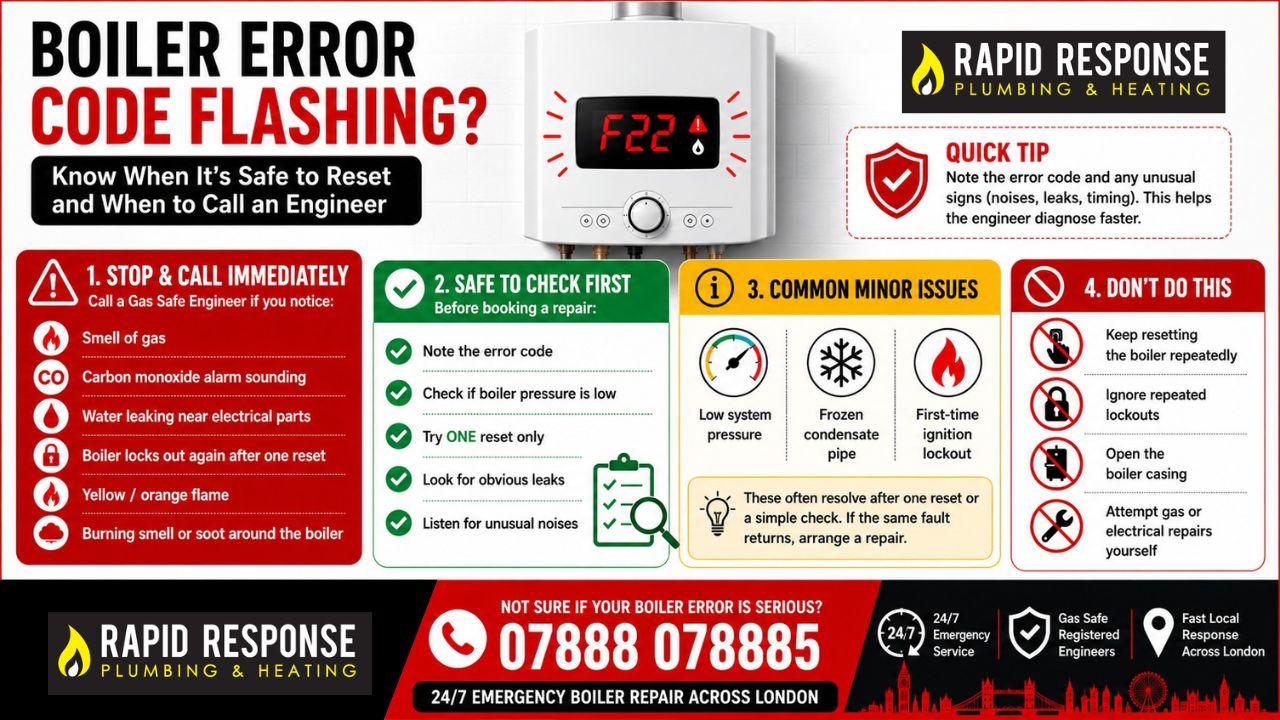
Can you smell gas, or has a carbon monoxide alarm gone off? If yes, stop reading, turn the boiler off at the isolation switch, ventilate the property, and call the National Gas Emergency Service on 0800 111 999 before doing anything else. No error code changes this instruction.
Is there visible water near the boiler casing, especially near any electrical connections? If yes, switch off the electrical supply to the boiler if it is safe to reach, and treat this as urgent regardless of what code is displayed.
Has the boiler locked out, been reset once, and then locked out again on the same fault within a short period? A single reset that holds are often fine. A code that returns within minutes or hours of a reset means the underlying fault is still present, and repeating the reset does not fix it. It can also mask the fault of an engineer or, in some cases, stress components further.
If none of these three apply, it is generally safe to move on to working out which tier your specific fault sits in.
What to Do While You Decide
Whatever tier the fault turns out to be, a few steps are worth taking immediately regardless. Note the exact code shown, along with anything unusual that happened just before it appeared, since that detail is often more useful to an engineer than the code itself. If the property has vulnerable occupants, young children, elderly residents, or anyone with a health condition affected by cold, treat any total loss of heating as higher priority even if the underlying fault sits in a lower tier, since the household’s ability to wait matters as much as the fault’s technical severity.
Tier One: Safe to Reset Once and Monitor
These faults are common, rarely dangerous on their own, and often resolve with a single reset or a straightforward check you can do yourself.
A low-pressure warning that has not yet caused a full lockout usually just needs the system pressure topped up using the filling loop, following your boiler’s specific instructions. A single ignition lockout that has never happened before, particularly after the boiler has been idle for a while, often clears with one reset. A frozen condensate pipe, recognisable by a gurgling sound before shutdown and a code specifically referencing blocked condensate, can often be resolved by gently warming the external pipe with warm, never boiling, water. For a closer look at how this plays out on a specific model, our guide to a Worcester boiler losing heat in Hackney walk through the same fault from an engineer’s first visit.
If a fault in this tier clears after one attempt and does not return, no further action is usually needed beyond keeping an eye on it over the following days.
Tier Two: Book a Repair, But It Can Wait for a Scheduled Visit
These faults mean something needs to be fixed, but they are not usually dangerous in the short term and do not typically justify paying emergency callout rates.
Hot water working while heating does not, or the reverse, usually points to a diverter valve or a flow sensor issue rather than anything safety related. A boiler that is noticeably losing pressure over days or weeks, rather than suddenly, often indicates a slow leak somewhere in the system that needs diagnosing but is not an immediate danger. Intermittent faults that appear, clear themselves, and reappear days later are worth noting carefully, including what was happening when they occurred, since that detail helps an engineer diagnose faster on the scheduled visit. Vaillant owners dealing with this pattern specifically may find our Vaillant boiler repair guide useful for the model-specific detail.
Tier Three: Call Now, Do Not Reset Again
These faults involve either a genuine safety risk or a fault that resetting will not be resolved and may make it worse.
Any code specifically related to gas valve function or flame detection that returns after a single reset needs a Gas Safe engineer before any further attempts. Repeated full lockouts, generally three or more within a short window, indicate the boiler safety systems are working correctly by refusing to keep trying, and continuing to force resets does not address whatever is wrong. A burning smell, visible soot marks around the boiler casing, or a yellow or orange flame instead of a crisp blue one is all signs of incomplete combustion and should be treated as urgent regardless of whether an error code is even showing. The same urgency applies if you notice visible water leaking from the boiler casing or if a fault is accompanied by loud banging, kettling, or whistling noises, both of which warrant the same immediate response.
Why the Same Code Can Mean Different Things on Different Days
This is the detail most guides skip entirely. A low-pressure code on a boiler that has never shown it before, on a system that was recently topped up and serviced, is genuinely low at risk. The identical code on a boiler that keeps losing pressure every few days despite repeated top-ups is a different situation entirely, even though the display is showing exactly the same characters. The code identifies the symptoms. It does not tell you the pattern, and the pattern is usually what separates a five-minute fix from a fault that needs a proper diagnosis.
This is also why engineers ask what happened before the fault appeared, not just what the code says. A code that appeared during the first heating demand after months of disuse tells a different story to the same code appearing on a boiler that has been running daily without issue for years.
Quick Cross-Brand Reference
| Situation | Worcester | Vaillant | Ideal | Typical Tier |
| Low system pressure | EA (early stage) | F.75-adjacent low-pressure alert | E118 | One or Two |
| Ignition or flame failure | EA | F28 / F29 | L2 / E133 | One if first time, three if repeated |
| Condensate blockage | D5 / EA variants | F28 | L2-adjacent | One |
| Gas valve or PCB related | F27-adjacent faults | F27 | E135 | Three |
| Fan fault | Varies by model | F.28-adjacent | F3 | Two, three if repeated |
Exact codes vary by specific model and firmware version even within the same brand, so treat this table as a general orientation rather than a definitive lookup. Your boiler’s own manual, or a quick photo sent to an engineer, will confirm the specific code faster than searching for a generic list.
Related Reading
Once the immediate fault is sorted, it’s worth understanding the wider picture around getting it fixed properly. If you’re calling an engineer for the first time, our guide on verifying a genuinely Worcester Bosch accredited engineer explains what to check before booking. If cost is a factor in whether you book now or wait, is boiler cover worth it in London breaks down when paying cover makes sense versus paying per repair. And for a fuller picture of what a repair visit itself involves, see our guide to what actually happens during an emergency boiler repair visit.
Not Sure Which Tier Your Fault Falls Into?
If you are staring at a code right now and are not certain whether it can wait, a quick call is faster and safer than guessing from a generic list.
RapidHeat247’s Gas Safe registered engineers can talk you through what you are seeing over the phone and tell you honestly whether it needs an emergency visit or can be booked in as a standard repair. Call 07888078885 for a straight answer.
Read more London boiler and heating guides on our blog: https://www.rapidheat247.co.uk/blog/
Frequently Asked Questions
One reset is generally fine. If the same fault returns after that single reset, further resets rarely fix the underlying issue and can occasionally mask the fault or add strain to components. At that point, it is worth booking a diagnosis rather than continuing to reset.
No. Many codes indicate a minor issue, such as low pressure; that does not stop the boiler from working once addressed. The code is a warning system, not necessarily a breakdown indicator.
Treat it as an emergency if there is any smell of gas, a carbon monoxide alarm has activated, water is visible near electrical components, or the same fault keeps returning after a reset. Outside of those situations, most codes can wait for a scheduled repair visit.
This can happen when there are multiple minor issues occurring close together, or when one underlying fault is triggering several different safety responses depending on exactly when the boiler shuts down. It is worth reporting all the codes you have seen, not just the most recent one, when you book an engineer.
For simple issues like low pressure, yes, provided you follow your specific model’s instructions carefully. Anything involving the gas valve, ignition system, or internal electrical components must be handled by a Gas Safe registered engineer, since it is both a legal requirement and a genuine safety issue.