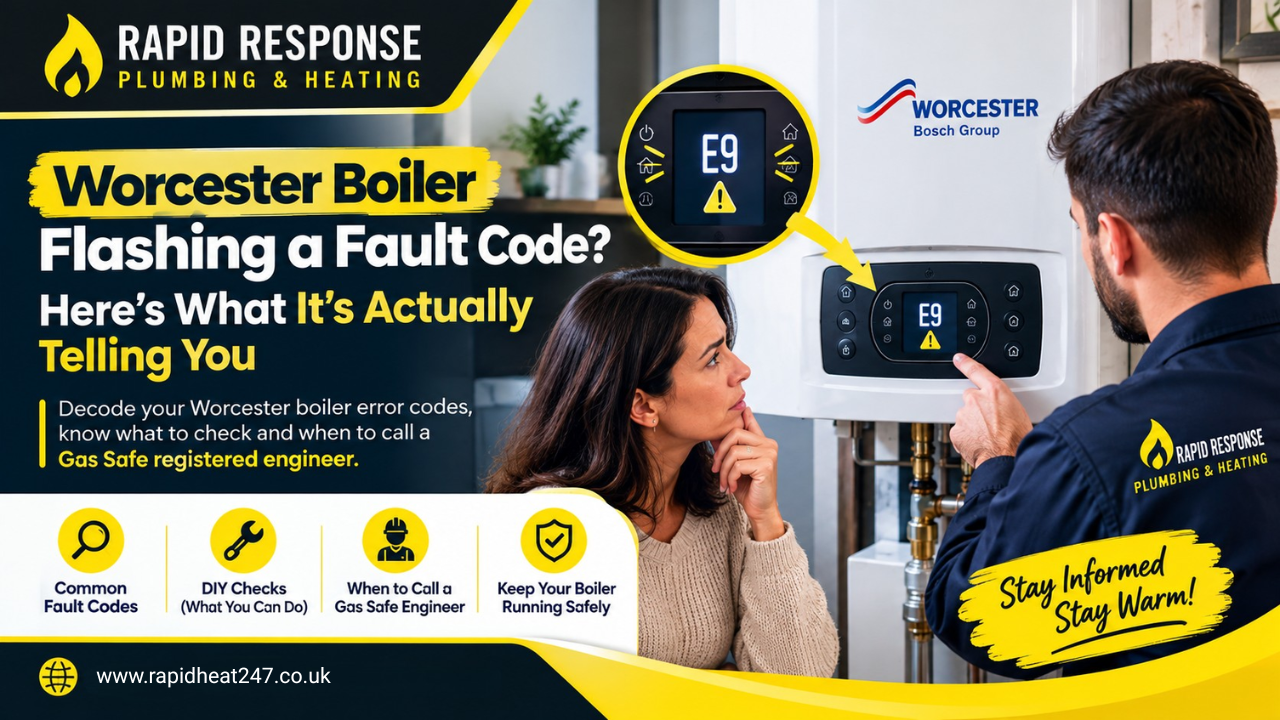
There’s a specific kind of dread that comes with walking past the boiler cupboard and seeing a flashing letter and number combination where your hot water is supposed to be. If you own a Worcester Bosch boiler, one of the most common brands installed across London, that display is not random. Worcester’s fault codes are one of the clearest diagnostic systems in the industry, and most of them point to a specific, identifiable problem.
The trouble is, a quick Google search often throws up conflicting information, because codes like L1, L2 or E110 that appear on some boiler advice sites actually belong to Ideal boilers, not Worcester. If your Worcester Bosch display is showing a code, it will follow Worcester’s own format, which is usually a letter followed by a number (like EA, E9, A1 or C6), sometimes paired with a three-digit cause code (like 227 or 224).
This guide breaks down what your Worcester boiler is genuinely telling you, what you can safely check yourself, and when it’s time to call a Gas Safe registered engineer for proper Worcester Boiler Repair Services in London.
Why Is My Worcester Boiler Showing an Error Code?
Worcester Bosch boilers are built with safety sensors that constantly monitor water pressure, flow temperature, flame presence and fan speed. The moment one of these readings falls outside a safe range, the boiler’s control board shuts the system down and displays a code, rather than letting a fault run unchecked.
Worcester splits these into two broad categories:
- Blocking errors. The boiler pauses temporarily (often for a few minutes) without displaying a permanent code, usually while it waits for a condition to clear, such as a temperature settling down.
- Locking errors. The boiler shows a flashing fault code with a warning triangle and shuts down completely until it’s reset or repaired. These are the ones homeowners usually notice and worry about.
If your display shows a locking error more than once after a reset, that’s a signal to stop resetting it and get it looked at, rather than risk the fault escalating into something more expensive, like a damaged heat exchanger or pump.
Worcester Boiler Error Codes: What Each One Actually Means
Below is a breakdown of the fault codes London homeowners with Worcester Bosch Greenstar boilers report most often, based on the manufacturer’s own diagnostic categories.
| Code | What It Means | Likely Cause |
| EA (227) | No flame detected after ignition | Failed ignition attempt, often a frozen condensate pipe in winter |
| EA (229) | Loss of flame signal during operation | Established flame extinguished, commonly a blocked condensate trap or strong wind into the flue |
| E9 (224) | Max temperature thermostat activated | Flue gas thermostat has detected overheating |
| E9 (219) | Safety sensor temperature too high | Main heat exchanger has overheated, often linked to sludge or a blocked pump |
| A1 | Pump stuck or running dry | Air in the system, a seized pump, or low water flow |
| C6 (215) | Fan speed too high or too low | Blocked flue, faulty fan motor, or a control board issue |
| D1 (240/241) | Return sensor error | Sensor is wet, damaged, or disconnected |
| E2 (222/223) | Flow sensor short circuit or disconnected | Faulty or damaged flow sensor |
| F0 (238) | Gas valve or control box error | Fault with the gas valve or the main control unit |
| CC | Outdoor sensor defect | Faulty external temperature sensor (weather compensation systems) |
| A7 | Domestic hot water sensor defect | Faulty sensor affecting hot water temperature readings |
| No code, tap symbol flashing | Low system pressure | Water loss through a leak, or pressure not topped up after bleeding radiators |
If your boiler is displaying a fault code we haven’t listed here, don’t try to interpret it from a generic chart. Worcester’s exact codes vary slightly between the Greenstar i, Greenstar CDi, Greenstar 4000 and 8000 Style ranges, so the safest step is to read the code and cause number exactly as shown and have an engineer confirm it over the phone before booking a visit.
Which of These Can You Fix Yourself?
A small number of Worcester faults are safe for a homeowner to check without opening the boiler casing:
- Low pressure (tap symbol). If your gauge reads below 1 bar, you can usually top it up yourself using the external filling loop, following the instructions in your boiler manual. If pressure keeps dropping every few days, that points to a leak somewhere in the system and needs a professional inspection.
- EA lockout in freezing weather. Before calling anyone, check the white plastic condensate pipe running outside your property. If it’s frozen, thawing it gently with warm (not boiling) water and pressing reset can solve the fault immediately.
- A single reset. Most Worcester boilers allow one reset via the display. If the same code returns straight away, stop resetting it repeatedly, as this can mask a more serious fault or, in the case of gas related errors, isn’t safe to keep attempting.
Everything else on that table, including flame detection faults that keep returning, sensor errors, fan faults and gas valve errors, involves gas-carrying or electrical components and legally requires a Gas Safe registered engineer to open the boiler, test the part, and carry out the repair.
Common Reasons London Boilers Fault More Often
London’s older housing stock and hard water supply create specific pressures on Worcester boilers that homeowners in other parts of the UK don’t always face:
- Hard water scale. Much of London sits on hard water, which speeds up limescale build-up inside the heat exchanger, a common contributor to E9 overheat faults over time.
- Victorian and converted properties. Older pipework and flats converted from period houses can lead to airlocks and pressure loss, both of which trigger A1 and low-pressure faults more frequently. Our guide on why boilers keep losing pressure covers this in more detail.
- External condensate pipes. Many London installations route the condensate pipe outside, which is exactly what causes EA lockouts every cold snap. We’ve also covered how boilers behave differently in summer versus winter, which explains why faults often surface at the start of the heating season.
If you’re unsure whether a flashing code is urgent or can wait until morning, our post on how to tell if a boiler error code is serious walks through how to judge it before you decide to call someone out.
Worcester Boiler Repair Services in London, Done Properly
At Rapid Response Plumbing and Heating, we’re a Worcester Bosch approved team of Gas Safe registered engineers covering London and the surrounding areas, with over 30 years of combined experience between us. When you call about a fault code, we ask for the exact code and cause number over the phone so we can turn up already knowing what to check, rather than diagnosing from scratch on your doorstep.
Whether it’s a stubborn EA lockout, a pump that’s stuck on A1, or a boiler that’s dropped pressure overnight, our emergency boiler repair service in London runs 24/7 with a fast response time, and we carry manufacturer-approved parts on the van to fix most Worcester faults on the first visit. If your boiler is faulting repeatedly and you’re weighing up repair against replacement, our Worcester Bosch and Vaillant boiler maintenance service can also catch developing sensor and pressure issues before they become a full breakdown.
Boiler flashing a code right now? Don’t keep resetting it and hoping. Call our engineers on 07888078885 for same-day Worcester boiler repair services in London, or use our online booking form to arrange a visit at a time that suits you.
Frequently Asked Questions
EA means the boiler has either failed to detect a flame after trying to ignite (cause code 227) or lost an established flame during operation (cause code 229). In winter, this is very often a frozen condensate pipe rather than an internal fault.
E9 indicates an overheat fault, meaning a safety sensor or thermostat has detected the flow temperature or heat exchanger running hotter than it should. This should be checked by a Gas Safe engineer rather than reset repeatedly.
Repeated pressure loss usually means there’s a small leak somewhere in the system, a faulty pressure relief valve, or air that needs bleeding from the radiators. Topping it up once is fine, but if it keeps dropping, book an inspection.
A single reset is generally fine. If the same code returns immediately or repeatedly, stop resetting it and call an engineer, since continuing to reset a gas-related fault can be unsafe and may worsen the damage.
Our team offers 24/7 emergency callouts across London, with engineers typically able to reach you the same day. Call 07888078885 and describe the fault code you’re seeing so we can prioritise the visit correctly.