
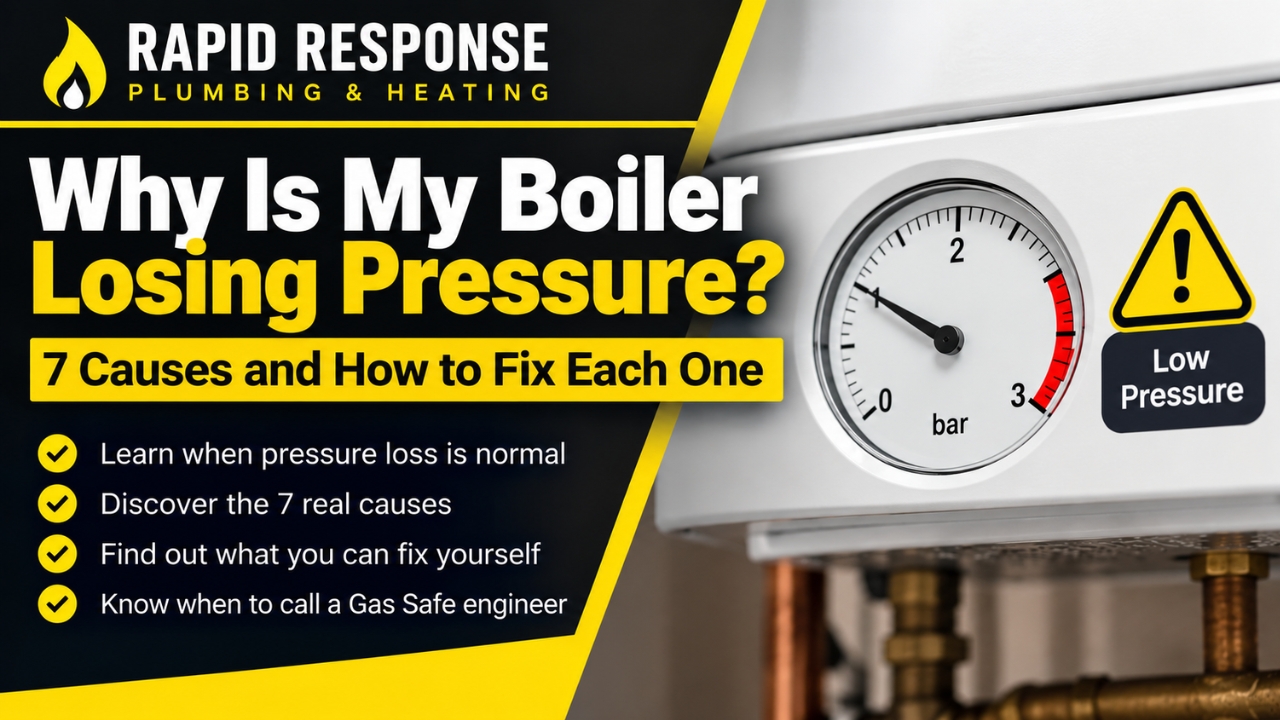
Quick answer: A boiler loses pressure when water or air escapes the sealed heating system, usually through a leak, a recently bled radiator, or a failing part such as the expansion vessel or pressure relief valve. Most boilers should sit between 1.0 and 1.5 bars when cold. If you top up and it drops again within days, something specific needs fixing, not another top-up.
We get called out to pressure-related jobs across London more than almost any other boiler fault, and the pattern is always the same. Someone tops up the system; the heating works again for a week or two, then the pressure drops again. Topping up treats the symptoms, not the cause.
This guide walks through the seven real causes we see on jobs across Hackney, Islington, and the wider London area, how to tell if your boiler pressure is too low for a genuine reason, and when it’s safe to sort it yourself versus when you need a Gas Safe registered engineer covering your part of London.
What Counts as Normal Pressure Loss (and What Doesn’t)
Before running through the causes, it helps to know how fast is too fast. This is the bit most guides skip, and it’s the question we get asked on almost every call-out.
| Pressure drop | What it usually means |
| 0.2 to 0.3 bar over several months | Normal. Small amounts of air settle out of the water over time. |
| 0.2 bar within one to two weeks | Worth investigating. Likely a slow leak or a failing component. |
| Needing a top-up every few days | Stop topping up and get it checked. There’s an active fault. |
| Sudden drop to zero | Possible major leak or valve failure. Turn off the boiler and arrange emergency boiler repair straight away. |
If you’re topping up more than once every couple of months, don’t keep repeating the same fix. That masks a fault until it becomes a bigger, costlier repair.
1. A Leak Somewhere in the System
This is the most common cause by a wide margin, and in London’s older housing stock it’s often hardest to spot. Victorian and Edwardian properties frequently have pipework hidden behind original skirting boards or under floorboards, and even a pinhole leak in a joint can drain a system slowly enough that you never see a puddle.
What to check: Look around radiator valves, visible pipe joints, and underneath the boiler for damp patches, rust staining, or bubbling paint on nearby skirting. Dry any suspicious joint with a paper towel and check it again after an hour.
When to call someone: If you can’t find the source, but the pressure keeps dropping, don’t keep guessing. Hidden leaks behind walls or under floors need a proper diagnostic, not repeated top-ups, and our team handles hidden pipework and plumbing repairs alongside boiler faults, so both can often be sorted on the same visit. If you’re dealing with an older London property, our guide on Victorian house plumbing problems covers exactly this kind of hidden pipework issue in more detail.
2. Recently Bled Radiators
If you’ve bled a radiator to clear trapped air and the heating suddenly feels more even, but the pressure gauge has dropped, that’s expected. Releasing air from the system releases a small amount of water with it, which naturally lowers the pressure.
What to do: Top the system back up using the filling loop until the gauge reads between 1.0 and 1.5 bar, then close the valve firmly. This is one of the few pressure issues that’s genuinely safe to fix yourself in most cases.
3. A Faulty Expansion Vessel
Every sealed heating system has an expansion vessel, a small tank that absorbs pressure changes such as water heats and cools. When it fails, usually because the internal rubber diaphragm has worn out or the vessel has lost its air charge, pressure becomes erratic rather than steadily falling. You might see it climb unusually high when the heating’s running, then drop sharply once it cools.
What to do: This isn’t a DIY fix. An engineer can test the vessel’s pre-charge pressure with a tyre-style gauge and either re-pressurise or replace it. On jobs where we’ve found this fault, it’s usually a boiler that’s five years or older and has never had the vessel checked during a heating servicing visit, which is one of the reasons annual servicing catches this before it becomes an emergency.
4. A Faulty Pressure Relief Valve (PRV)
The PRV is a safety device designed to release water if the system pressure gets dangerously high. If it’s stuck slightly open, or the seal has worn, it will slowly weep water even at normal operating pressure, and you’ll often find a small drip coming from a pipe on the outside of your house.
What to check: Look outside your property, usually near where your boiler is located, for a pipe dripping even when the heating isn’t running. That’s the PRV discharge pipe, and if it’s dripping constantly, the valve needs replacing.
When to call someone: Always. PRV replacement involves working directly on a gas appliance and should only be done by a Gas Safe registered engineer.
5. The Filling Loop Not Fully Closed
The filling loop is the flexible hose (often silver or braided) used to top up pressure manually. If it isn’t closed tightly after use, or the internal valve has a worn seal, it can let water seep through slowly, which looks identical to a system leak from the outside.
What to do: Check that both ends of the filling loop are closed firmly. If pressure keeps dropping even after you’ve confirmed it’s closed properly, the valve itself may need replacing, which is a straightforward job for an engineer.
6. Trapped Air or an Airlock
Air trapped in the system can cause pressure to read lower than it is, particularly after any work has been done on the heating system. This is usually accompanied by cold spots at the top of radiators or gurgling noises from the pipework.
What to do: Bleeding the affected radiators usually clears this. If cold spots persist afterwards, there may be a partial blockage rather than just trapped air.
7. Internal Boiler Component Faults
Occasionally the cause sits inside the boiler itself, a failing heat exchanger seal or a fault in the primary circuit. This is less common than the six causes above but tends to come up with other symptoms too, such as an error code on the display or the boiler locking out repeatedly.
What to do: If you’ve ruled out an external leak, a recently bled radiator, and a stuck filling loop, and the pressure is still dropping alongside error codes or other faults, it’s time for a full diagnostic. Our guide to common Worcester Bosch boiler problems and our boiler error codes guide both cover the specific fault codes that often appear alongside pressure loss, and matching the code to the cause can save an engineer time (and your money) on the visit.
Does London’s Hard Water Make This Worse?
Yes, and it’s a factor most national guides don’t mention. Much of London sits in a hard water area, and over years of use; limescale can build inside pipework, around valve seats, and inside the expansion vessel. This doesn’t cause pressure loss directly, but it accelerates wear on the exact components covered above, particularly the PRV and expansion vessel, meaning boiler pressure problems in London postcodes often show up slightly earlier than the manufacturer’s typical lifespan would suggest. An annual service that includes a limescale check is worth the modest cost if you’re in a hard water area and haven’t had one recently.
When Your Boiler Keeps Losing Pressure: Time to Call a Gas Safe Engineer
Topping up pressure once or twice a year is normal. If your boiler keeps losing pressure more often than that, or if you’ve spotted a genuine leak, a dripping PRV, or error codes alongside the drop, it’s time to get it looked at properly by a Gas Safe registered engineer rather than keep patching the symptom. Left unresolved, persistent low boiler pressure can lead to the boiler locking out entirely, and in some cases, damage to internal components that turn a straightforward repair into a full replacement.
If you’re anywhere across London and your boiler pressure is too low or won’t hold steady, our Gas Safe registered engineers can usually diagnose the actual cause on the first visit rather than guessing. Call us on 07888 078885 or book an appointment online at www.rapidheat247.co.uk, and if you’re weighing up repair against a full system upgrade, our boiler installation page has more detail on when replacement makes more sense than another repair. You can also get in touch if you’d rather talk about it through before booking.
Frequently Asked Questions
Once or twice a year is normal for a healthy sealed system. If you’re topping up monthly or more often, there’s an underlying fault that needs investigating rather than repeated top-ups.
Yes, topping up pressure using the filling loop is safe for most combi boilers and is designed to be done by homeowners. Always check your boiler’s manual first, and never attempt repairs to the pressure relief valve or expansion vessel yourself.
Most boilers should read between 1.0 and 1.5 bar when the system is cold. Check your specific boiler’s manual, as some manufacturers recommend slightly different ranges.
Hidden leaks behind walls or under floors are common in older London properties, and a faulty expansion vessel or pressure relief valve can also cause pressure loss with no visible water. Both need a Gas Safe engineer to diagnose properly.
Yes. If pressure drops too low, most boilers will lock out and stop working to protect internal components. Ignoring repeated pressure loss can also lead to more serious internal faults over time.
This depends entirely on the cause. A closed filling loop or bled radiator top-up costs nothing. A faulty expansion vessel or PRV replacement is a straightforward repair. A hidden leak in pipework can vary depending on access. Contact us on 07888 078885 for an accurate quote based on your specific situation.