
Your Vaillant boiler flashes a code. You press reset. It fires up, then fails again twenty minutes later. Most of us have been there, especially on the first cold mornings of winter.
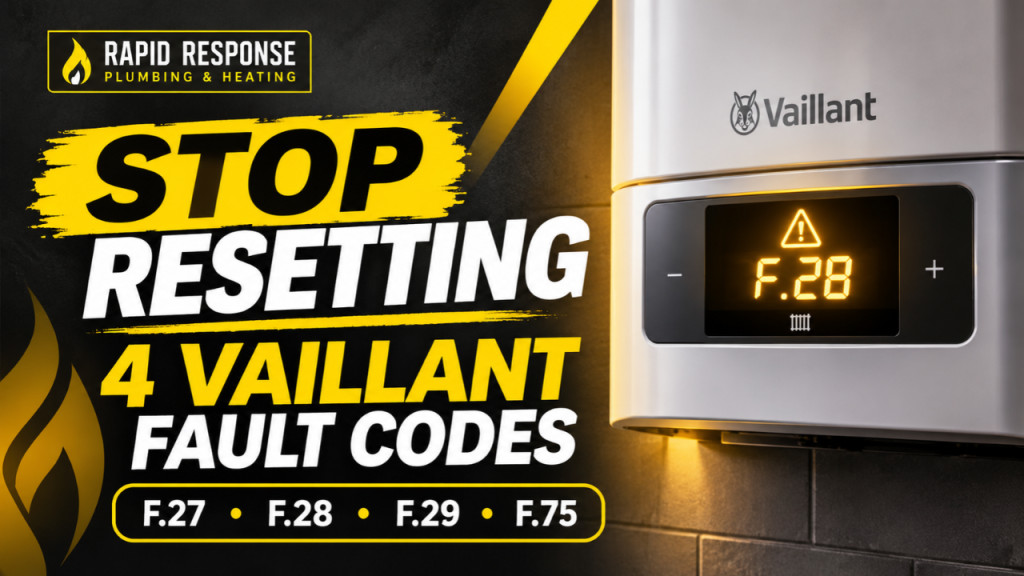
With some codes, a reset is a sensible first step. With four of them, it is not. The Vaillant fault codes F.27, F.28, F.29 and F.75 point to flame, ignition or circulation problems. Pressing reset again and again does not repair any of them, and it can turn a small job into an expensive one.
This guide explains what each code means, what you can safely check, and when it is time to book emergency boiler repair in London.
Quick answer: Press reset once at most. If F.27, F.28, F.29 or F.75 comes back, stop and call a Gas Safe registered engineer. If you smell gas, leave the property and call the National Gas Emergency Service on 0800 111 999.
What Does a Vaillant Reset Actually Do?
A reset clears the lockout and asks the boiler to try again. It does not repair anything. If the cause is still there, the boiler locks out again, often within minutes.
Think of a smoke alarm that keeps beeping. Silencing it does not remove the smoke. A fault code works the same way, because it is a warning from a safety system.
Repeated resets cause three problems:
- They hide the pattern. An engineer needs to know how often the code returns and how quickly.
- They add wear. Repeated ignition attempts and a pump running without proper flow put extra strain on parts.
- They tempt you to carry on. Some of these faults involve gas, so carrying on is not worth the risk.
The 4 Vaillant Fault Codes to Stop Resetting
Here is the short version. The detail for each code follows below.
| Code | What it means | Keep resetting? | Next step |
| F.28 | Ignition failed at start-up | No | Quick safe checks, then call |
| F.29 | Flame lost while running | No | Call an engineer |
| F.27 | Flame detected when there should be none | No | Call an engineer, treat as urgent |
| F.75 | Pump or pressure sensor fault | No | Check the gauge, then call |
F.28: The Boiler Tried to Light and Failed
Vaillant lists F.28 as a failure during start-up, where ignition was unsuccessful. The boiler tries to light, cannot, and locks out to stay safe.
Common causes include:
- A gas supply problem
- A worn or faulty ignition electrode
- A blocked or frozen condensate pipe
- A fault with the gas valve
Safe checks before you call:
- Check that your gas is on. Does the hob light? If you have a prepayment meter, check your credit.
- In freezing weather, look at the plastic condensate pipe that runs outside. If it is frozen, pour warm water (never boiling) over it. Our guide to the frozen condensate pipe is written for Worcester boilers, but the same pipe problem applies to Vaillant.
- Press reset once. If F.28 returns, stop.
Electrodes and gas valves are gas components. In the UK, only a Gas Safe registered engineer can legally work on them.
F.29: The Flame Lit, Then Went Out
F.29 is the cousin of F.28. The boiler lights normally, then loses the flame while it is running. You might get heating for a short while before it shuts down.
Possible causes include an interrupted gas supply, a restricted flue or condensate pipe, or a gas valve that is working intermittently. These are hard to spot without testing equipment.
Note how long the boiler runs before it drops out. That one detail helps an engineer decide whether to look at the gas supply, the flue or the valve first.
F.27: The Boiler Thinks There Is a Flame When There Is None
Vaillant describes F.27 as a safety switch-off caused by flame simulation. The monitoring electrode reports a flame that should not be there.
This can come from a gas valve that is not closing fully, moisture, or a faulty electrode or control board. Because gas may still be reaching the burner, treat F.27 as urgent. Do not keep pressing reset.
If you smell gas at any point, switch off nothing electrical, open windows, leave the property and call 0800 111 999.
F.75: The Pump Is Running but Nothing Is Changing
F.75 appears when the boiler starts the pump and sees no change in pressure. That points to a failing pump, a faulty pressure sensor, or sludge that is restricting flow.
It is not a gas fault, but the boiler cannot confirm that water is circulating, so it locks out. Resetting repeatedly only makes the pump try again against the same problem.
Check that the pressure gauge reads normally. If the gauge looks fine and F.75 keeps coming back, the sensor or pump needs testing. Older systems with sludge may need a power flush once the fault is fixed. For the full breakdown, read our guide to Vaillant F.75.
What About F.22? The One You Can Usually Fix First
F.22 means low water pressure. On many Vaillant models the display warns you when pressure falls below 0.8 bar, and the boiler shuts down with F.22 when it drops below 0.5 bar.
This is the code where a reset does make sense, but only after you have fixed the cause:
- Check the pressure gauge.
- Use the filling loop to bring the pressure up to around 1.0 to 1.5 bar when the system is cold. Your manual gives the figure for your model.
- Close the valves, then press reset once.
If the pressure drops again within a few days, there is a leak or an expansion vessel problem. Topping up again will not cure it. Our guide on why a boiler keeps losing pressure lists the usual causes.
Call Now or Wait Until Morning?
Not every code needs a midnight call-out. Use this as a guide.
Call straight away if:
- You smell gas or your carbon monoxide alarm sounds
- The code is F.27
- Water is leaking from the boiler
- There is no heating or hot water and the household includes a baby, an older person or someone unwell
- Temperatures are close to freezing and the system is off
Call the same day if:
- F.28, F.29 or F.75 returns after one reset
- The boiler runs for a short time, then locks out again
It can usually wait if:
- You fixed a single F.22 with the filling loop and the boiler runs normally afterwards
- A code cleared once and has not come back
Still unsure? Our guide to whether you need an emergency boiler engineer right now walks through the decision in more detail.
What to Tell the Engineer When You Call
A good phone call saves time on the doorstep. Have this ready:
- The exact code on the display
- Your boiler model, usually on the front panel (ecoTEC Plus, ecoTEC Pro or ecoFIT Pure)
- How many times you pressed reset
- When the fault started and how quickly the code returns
- The pressure gauge reading
- Any unusual noises or smells
- Whether other gas appliances, such as the hob, still work
- When the boiler was last serviced
With this information, the engineer can arrive with the right parts and avoid a second visit.
What Does Emergency Boiler Repair in London Cost?
The full price list is on our pricing page. For heating work, our current call-out rates for the first hour are (assumptions):
- Monday to Friday, 8am to 5pm: £120
- Monday to Friday, 5pm to 8am: £180
- Saturday and Sunday, 8am to 2pm: £180
- Saturday and Sunday, 2pm to 8am: £220
There is a minimum charge of one hour, then work is charged in 30 minute increments. The Congestion Charge and parking are not included. Ask the engineer to confirm any parts cost before work starts. Written and verbal quotes are available.
If an out-of-hours call-out feels like a stretch, the “call the same day” group above is where you can often choose a weekday slot instead.
How to Choose a Vaillant Boiler Engineer in London
When the heating is off, it is tempting to book the first number you find. Take two minutes to check these points.
- Gas Safe registration. Ask to see the engineer’s Gas Safe ID card. You can also check any engineer on the Gas Safe Register website.
- Vaillant experience. If you are searching for Vaillant approved service engineers, ask for evidence of Vaillant training or accreditation. Do not rely on a logo alone.
- A clear quote. You should know the call-out charge and the hourly rate before anyone starts work.
Our engineers are Gas Safe registered and work across London and within the M25 from our Hackney base. For model-specific help, see our Vaillant boiler repair service in Hackney page, or our wider emergency boiler repair across the City of London.
Want to read more first? Our guides on Vaillant boiler repair services in London and common Vaillant boiler problems and repair methods cover the wider picture, and our Vaillant error codes guide explains the rest of the codes.
Do Not Forget Carbon Monoxide
Any fault involving ignition or flame deserves a carbon monoxide check. Make sure you have a working CO alarm near your boiler and in your bedrooms.
Headaches, dizziness and nausea that ease when you leave the house are warning signs. If your alarm sounds, open the windows, leave the property and call 0800 111 999.
An annual boiler service is the best way to catch worn parts before they lock your boiler out in January.
Stuck on a Vaillant Code? Get Help Today
If your Vaillant is showing F.27, F.28, F.29 or F.75 and a single reset has not cleared it, stop pressing the button. Our Gas Safe registered engineers are available 24 hours a day, 365 days a year for emergency boiler repair across London.
Call 07888078885 now or book an emergency call-out online. You can also visit www.rapidheat247.co.uk to see all our boiler repair and servicing options.
Frequently Asked Questions
Press reset once at most. If the same code returns, there is an underlying fault. Your boiler manual may allow a set number of attempts, but repeated resets will not fix the cause.
F.28 means the ignition failed during start-up. Causes include a gas supply problem, a faulty electrode, a blocked or frozen condensate pipe, or a gas valve fault. Check your gas is on, press reset once, then call a Gas Safe engineer if it returns.
F.75 is a pump or pressure sensor fault rather than a gas fault. The boiler locks out because it cannot confirm that water is circulating. It still needs an engineer, so do not keep resetting it.
No. F.27 relates to flame detection and may involve the gas valve. Treat it as urgent and book a Gas Safe registered engineer.
Yes. We operate 24 hours a day, 365 days a year. Out-of-hours call-out rates are listed on our pricing page.