Ask a London plumber what worries them more, a five-year-old flat in Nine Elms or a Victorian terrace in Islington, and the answer is almost always the terrace. Distance on a map means nothing here. What matters is what’s actually running through the walls.
A modern flat usually has one manifold and plastic pipework, with a single owner responsible for everything behind the front door. Victorian terraces rarely work that way. Ours might carry three different pipe materials laid across three different decades. The stopcock hasn’t been touched since the previous owner moved out. Part of the water supply, in some cases, still technically belongs to the house next door.
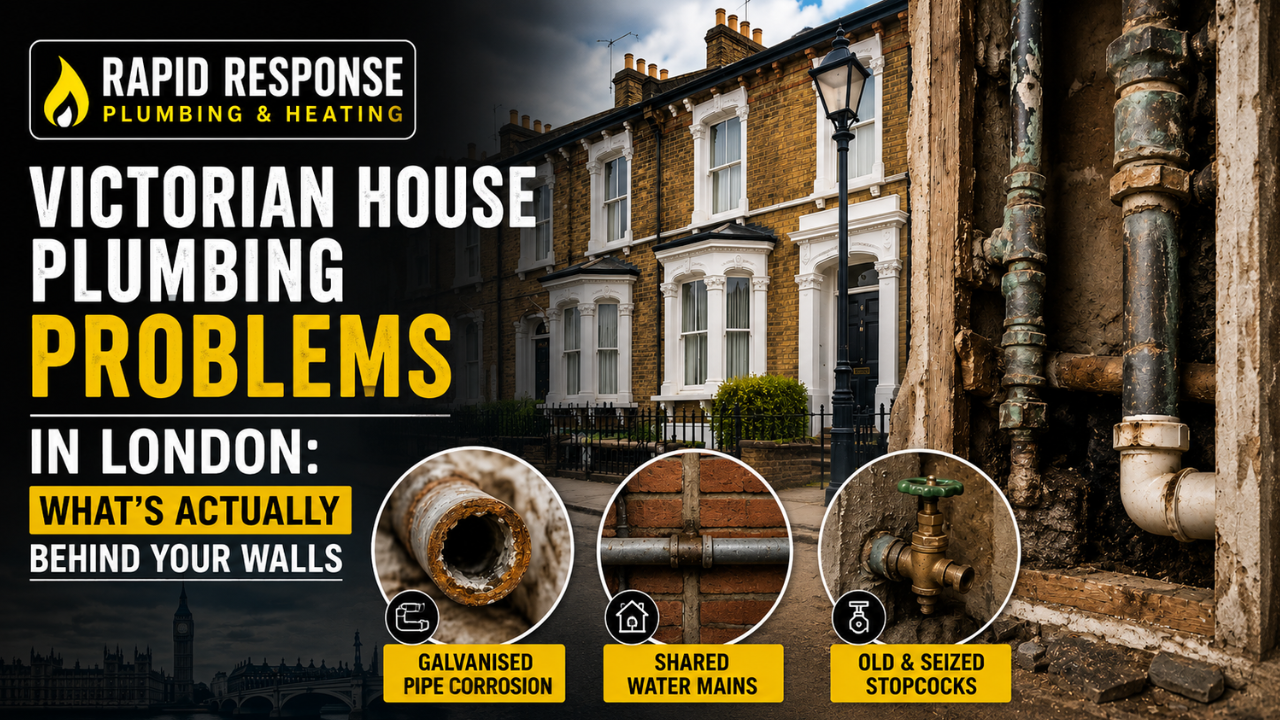
This isn’t really about age for its own sake. It’s a look at the building methods that shaped homes 150 years ago and why many of those choices still affect properties today. Victorian houses plumbing problems in London tend to fall into the same recurring handful of causes, and they sit at the heart of what makes period property plumbing in London genuinely different from newer housing stock. Understanding them, pipe by pipe and floor by floor, makes it far easier to know what you’re dealing with when something goes wrong.
Key Takeaways: Victorian House Plumbing Problems in London briefly
- Pre-1970 London homes are the ones most likely to still be connected via lead, with Thames Water’s own supply-area data putting the figure near one million properties
- Galvanised steel pipework, common in early-to-mid twentieth century additions, corrodes from the inside out. It causes leaks that stay invisible until they fail
- Victorian terraces converted into flats often share a single water supply pipe through a party wall. A leak or pressure problem can mean needing a neighbour’s cooperation to fix it
- Damp near a chimney breast is often not a plumbing leak at all. Porous masonry and failed flashing can produce identical symptoms
- Original stopcocks are frequently seized, buried, or shared with next door. This turns a routine shutoff into the hardest part of an emergency
- Suspended timber floors rely on airflow through small brick vents to stay dry.
- A blocked vent and a slow pipe leak can silently weaken structural joists for years before anyone realizes there’s a problem.
Why Lead Pipes Are Behind Many Plumbing Problems in London’s Period Properties
Lead was the standard material for domestic water supply throughout most of the Victorian era. UK Water Regulations only began phasing it out from the 1970s onwards. It was cheap. It bent easily around obstacles. And it resisted the corrosion that plagued iron pipework.
The problem is how much of it never got taken out. Thames Water’s own figures put the number of properties still connected via lead service pipes in its supply area at close to one million, a total driven largely by how much pre-war housing London has compared with anywhere else in the country.
For plumbing emergencies specifically, ageing leads to pipe matters for two reasons beyond water quality. First, it’s soft enough to be damaged by nearby building work or ground movement. Second, its joints were traditionally “wiped” with molten solder rather than the compression fittings used later. These older joints can fail in ways a modern plumber may not expect a first look.
If you’re unsure whether your property has any remaining lead pipework, a certified water test is a straightforward way to check. It typically costs between £30 and £80, and many water companies offer this for free on request.
Galvanised Pipe Corrosion: The Hidden Plumbing Problem That Can Lead to Costly Repairs
Between roughly the 1930s and 1960s, a lot of London properties had sections of their plumbing done in galvanised steel. This was a zinc-coated pipe, designed to solve the corrosion problems of plain iron. It worked for a while.
The zinc coating degrades from the inside first, somewhere nobody can see it happening. As it wears through, the bare steel underneath starts to rust. That rust builds along the internal wall of the pipe, narrowing the bore and restricting flow. This is why a lot of Victorian and early twentieth century London properties have taps that run noticeably weaker than they used to. It’s usually worse upstairs, or at the end of a long pipe run, and it happens long before anyone notices an actual leak.
Eventually the corrosion breaks through. This most commonly happens at the threaded joints, where the pipe wall is naturally thinnest. By the time water is visibly leaking, the internal corrosion has usually been progressing for years. If your water occasionally runs faintly brown or metallic tasting after a tap’s been unused for a day or two, that’s a reliable sign. In most cases, this indicates corrosion inside galvanised pipes rather than an issue with the mains water supply.
Shared Water Mains: Why Your Plumbing Emergency May Affect More Than Just Your Home
A significant number of Victorian terraces, particularly ones later split into flats, were built with a single water supply pipe serving two or more properties. It usually runs through or under a party wall before splitting. This one detail alone accounts for a lot of the Victorian house plumbing problems London engineers get called out for. Often the issue has nothing to do with the property’s own pipework at all.
This creates a genuinely different category of emergency. Under UK water regulations, this changes responsibility. Once a supply pipe crosses onto private land and serves more than one property, everyone it serves shares responsibility for it. It isn’t owned outright by whoever happens to be nearest to the leak.
A drop in your water pressure whenever a neighbour runs their shower is one of the more common everyday symptoms of this setup. A burst on a shared section is the more serious version. Locating and repairing it can require agreement, and sometimes access, from someone living next door.
If you live in a converted Victorian property, check whether your supply is shared or independent now. It’s worth finding out before an emergency forces the question. Your water company can usually tell you where the responsibility boundary sits, even if they can’t always tell you exactly where the pipe runs underground.
Chimney Breast Leaks Mistaken for Plumbing: A Genuinely Common Misdiagnosis
This is one of the most interesting failure patterns in Victorian properties. It isn’t a plumbing problem at all, but it’s frequently reported as one.
Chimney stacks in older London houses are built from porous masonry. During sustained rain, the brick and mortar can absorb water like a sponge, and gravity carries that moisture downward through the structure. Internal lead flashing is typically set only around 25mm into the masonry. Water can percolate past it and travel a further 100 to 150mm down inside the wall. It often reappears as a damp patch or stain on the internal plaster, well below the actual point of entry.
The result is a damp mark that can look exactly like a leaking pipe behind a wall. This is especially true if it appears near a chimney breast in a bedroom or living room. The genuine giveaway is timing. Chimney-related damp typically worsens noticeably after heavy or sustained rain and can ease off in dry spells. A plumbing leak, by contrast, is generally more constant regardless of the weather.
If a plumber attends a suspected leak near a chimney breast and finds no pipework nearby, this is very often the real explanation. The fix is a roofer or chimney specialist checking the flashing and pointing, not further plumbing work.
Original Stopcocks: Still There, Rarely Where You’d Expect
Every property needs a way to shut its water off in an emergency. In a huge number of Victorian London homes, that stopcock is the original one, sometimes over a century old. Finding it is often harder than dealing with the leak itself.
Common locations include under original floorboards near the front door, in old coal cellars, and behind fitted kitchen units installed decades after the stopcock was. Some are in a small, buried chamber outside that’s since been paved, decked, or built over entirely. In converted flats, a single stopcock may control the whole building. It’s often buried somewhere in a shared area, and individual flats may have no independent shutoff at all.
Even once located, an original stopcock that hasn’t been turned in years is frequently seized solid with limescale and corrosion. It either won’t move, or, if forced, it can shear off inside the pipe and turn a manageable leak into a serious one.
This is exactly why testing your stopcock every few months is such a useful habit. It’s one of the best habits a homeowner in an older London property can build. Simply turn it off and back on. It costs nothing and takes under a minute. It’s also the difference between shutting off a leak yourself in thirty seconds and waiting for an emergency plumber. Without that habit, they may end up fighting a seized valve while water keeps flowing.
Hidden Voids and Wooden Suspended Floors: Where Small Leaks Become Big Structural Problems
Most Victorian ground floors in London weren’t built as solid concrete. They’re suspended timber floors, with floorboards resting on joists. Underneath, short brick walls called sleepers carry the weight of those joists. Builders left deliberate gaps between the bricks in a honeycomb layout, purely so air could pass through rather than pool. That air enters through small vents in the outside walls, known as air bricks.
This ventilation is what keeps the timber dry over a void that often sits directly above bare earth. It works well when the airflow is unobstructed. The problem is decades of patios, decking, flowerbeds, and even simple repointing. These can end up blocking or burying those original air bricks without anyone realising it. Once the airflow stops, humidity in the void starts to climb.
Combine that with even a very small, slow leak. A weeping joint under a bath, or a slightly loose connection on a heating pipe crossing the void, creates exactly the conditions structural timber can’t tolerate. Joists don’t need a dramatic burst to start rotting. Persistent low-level moisture is enough, particularly at the joist ends where they rest into or against masonry.
Wet rot can develop over months without producing an obvious drip anywhere. It usually only reveals itself later, as a soft or springy patch of floor. By that point, what began as a minor plumbing weep has become a structural repair involving replacing rotted joists, not just fixing a pipe. This is part of why an experienced plumber will often ask about suspended floor ventilation. They check this alongside the pipework itself when investigating a slow or unexplained damp issue in a Victorian property.
What Victorian House Plumbing Problems Actually Mean for a London Homeowner
None of this is a reason to be alarmed about owning a period of property. It’s a reason to expect a different, more thorough approach from whoever you call when something goes wrong. Period property plumbing in London is a different skill set from new-build work. The tools aren’t different. What’s different is that diagnosing it correctly requires understanding a building method that stopped being taught decades ago.
If you own or rent a period of property anywhere in London, it’s worth asking directly: has this plumber worked on Victorian or Edwardian properties before? Do they understand the difference between a plumbing leak and a chimney leak? Do they know a private supply pipe from a shared one before they even start work?
Need a Plumber Who Actually Understands London’s Period Properties?
At Rapid Heat 247, our Gas Safe registered engineers work across London’s Victorian, Edwardian, and converted period properties every week. We understand the difference between a shared supply pipe, a suspended floor void, and a chimney leak before a single tool comes out. As one of the more established providers of emergency plumbing services in London, we combine that with professional plumbing services in London covering everything from stopcock replacement to full supply pipe repairs, for homeowners, tenants, landlords, and commercial properties.
For what to do once an emergency has been resolved, including how it interacts with your home insurance, read our guide on what happens after the plumber leaves.
📞 Call now: 07888078885 🌐 Visit: www.rapidheat247.co.uk
Genuine period property expertise, not a one-size-fits-all approach to London’s oldest housing stock.
Frequently Asked Questions
A certified water test from an accredited laboratory typically costs £30 to £80 and confirms lead levels directly. Many water companies, including Thames Water, offer free testing on request. It’s worth asking before commissioning a paid test.
This is a common sign of galvanised steel pipe corrosion. Rust builds inside the pipe and dislodges when water starts flowing again after standing still. It’s worth having a plumber assess the affected pipework rather than ignoring it, since internal corrosion tends to worsen over time.
Chimney-related damp typically gets noticeably worse after heavy or sustained rain and improves during dry weather. A genuine plumbing leak tends to stay constant regardless of the weather. If there’s no pipework anywhere near the affected area, that’s a strong signal the chimney structure itself is the cause.
Check original floorboards near the front door, coal cellars, and areas behind fitted units first. If you genuinely can’t locate it, your water company can usually help identify where responsibility begins. A plumber can also install an accessible isolation valve, so you’re not searching during a future emergency.
Not necessarily, but it’s worth knowing about before an emergency happens. If your property shares a supply pipe with a neighbour, responsibility for repairs is legally shared between everyone it serves. That can mean needing their cooperation to resolve a leak or pressure issue.